posted 09/09/10 01:53 PM | updated 09/09/10 01:53 PM
Featured Post! | Views: 0 | Comments : 7 | News
A Light Rail Rashomon on Twitter
Save and Share this article

|
Collisions and headlines |
|
| You're getting overworked about this. I didn't cover this story, but we write that the car driver made an illegal left turn, etc. I'll leave it to smarter people to argue in hindsight about whether politicians should have put the tracks at surface, a question we covered in the 2000s. The financial cost to Sound Transit of these collisions is (comparatively) tiny -- the bigger harm to Link is schedule reliability for the transit riders. Anyway, The Sunbreak is cool, good luck with building readerhip - Mike Lindblom, Seattle Times transportation reporter. |
|
|
Comment by Mike Lindblom
3 days ago
|
( 0 votes)  
( report abuse ) ( )
|
|
RE: Collisions and headlines |
|
| Hi Mike, thanks! I won't say it's the most important story of the day, but as a headline skimmer myself, I think it's important to break bad habits, which is what this seems to be. The cumulative impression--again, purely from the headlines--is that the train is causing the colliding, and it's just not. You're no doubt right about the reliability toll being the bigger issue than cost. I still think it might be a story worth pursuing, because it doesn't seem like drivers are learning not to make illegal lefts in front of the train. | |
|
Comment by Michael van Baker
3 days ago
|
( 0 votes)
( report abuse ) ( )
|
|
RE: Collisions and headlines |
|
| Mike Lindblom, Is it true that reporters don't write their own headlines? |
|
|
Comment by Martin H. Duke
3 days ago
|
( 0 votes)
( report abuse ) ( )
|
|
Headline |
|
| Remember the headline is there to get attention not to tell the story. Sensationalism sells. Also the "News Media" is all about sales not news. With the Times it is all about Ryan, not the truth. | |
|
Comment by Michael Gillman
3 days ago
|
( 0 votes)
( report abuse ) ( )
|
|
Who writes headlines? |
|
| That is true. Our reporters don't write the headlines. Sometimes, if I see a major problem in a headline (or photo caption), I will go to the editors' desk and ask for a change online. On the big A1 stories, editors will often show us the print page the night before, as an additional quality-control step. | |
|
Comment by Mike Lindblom
3 days ago
|
( 0 votes)
( report abuse ) ( )
|
|
Phrasing |
|
| Doesn't "Car Collides with Link" imply that the car struck the train? Regardless of fault, physically, the train hit the car, didn't it? I'm not a grammarian, and i acknowledge the implication of fault with the phrasing, but the Times version sounds more correct based on the facts. |
|
|
Comment by Frank
2 days ago
|
( 0 votes)
( report abuse ) ( )
|
|
RE: Phrasing |
|
| I read collides in that case as "car and train hit each other." ("Come together violently" is one definition of collide.) But I'd also accept "car and train collide." Really, my point is just that the news is that cars are creating light rail accidents, so however you phrase it, the first impression shouldn't be, "Oh, a train smashed into a car again." | |
|
Comment by Michael van Baker
2 days ago
|
( 0 votes)
( report abuse ) ( )
|
advertisement
Hello!
The SunBreak is an online magazine of news & culture. It's a conversation about all the things on Seattle's mind (more about us). Got a post for us? We'd like to see it. Or just send us . If you'd like to contribute regularly, .
Twitter: @thesunbreak | Facebook
iPhone app download (Free!)
Twitter: @thesunbreak | Facebook
iPhone app download (Free!)
advertisement
Subscribe to The SunBreak
Regular reader? Subscribe to The SunBreak for just $1 per month, and help keep the news & culture coming.
Delivery Options
 Subscribe to our Front Page Stories
Delivery Options
Subscribe to our Front Page Stories
Subscribe to all SunBreak Stories
Daily Email Digest of The SunBreak
advertisement
Latest Headlines
Recently in Our Flickr Photo Pool
www.flickr.com
|

Our Facebook Fan Page
Neighborhood Blog News
Niche Blog News
Seattle Weather
Get the SunBreak iPhone App
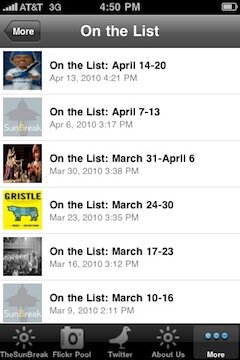
Download the SunBreak iPhone app for free.
Not a Member?
Sign Up

Most Recent Comments